
Why your room doesn't feel right after dark
It's probably not the furniture.

Most rooms have light. Fewer have lighting.
The distinction sounds pedantic until you’ve sat in a room at 9pm that has a beautiful pendant, proper furniture, everything chosen with care — and something still isn’t right.
Flatter than it should be. Less comfortable than the furniture deserves.
The answer is almost always layering.
A lot of domestic interiors rely entirely on one type of light: ambient light from above. A central pendant. Maybe a dimmer if someone remembered.
But good rooms combine at least three different sources — general illumination (ambient) from above, directed light for reading or working (task), and lower-level sources (decorative) that create focus, shadow and variation.
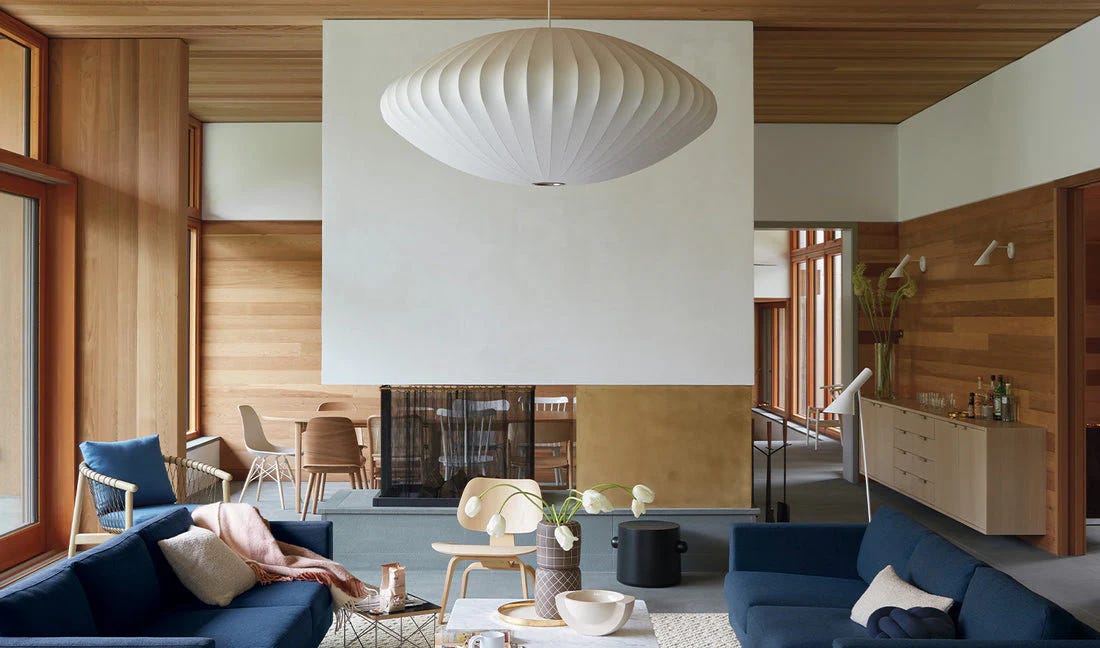
Ambient Lighting: The Pendant / Suspension Lamp
Ambient light is what most rooms get and nothing else. One source, overhead, filling the room with an even wash that eliminates shadow and, with it, atmosphere.
The problem isn’t ambient light. It’s ambient light alone. Used well, overhead lighting establishes the room’s base level: enough to move around comfortably, not so much that the space feels clinical.
The Nelson Bubble Lamp distributes light in every direction, casting a soft glow that reads almost like candlelight from a distance. The Akari lamps do something similar: Isamu Noguchi’s washi paper shades absorb the bulb’s harshness and return something quieter.
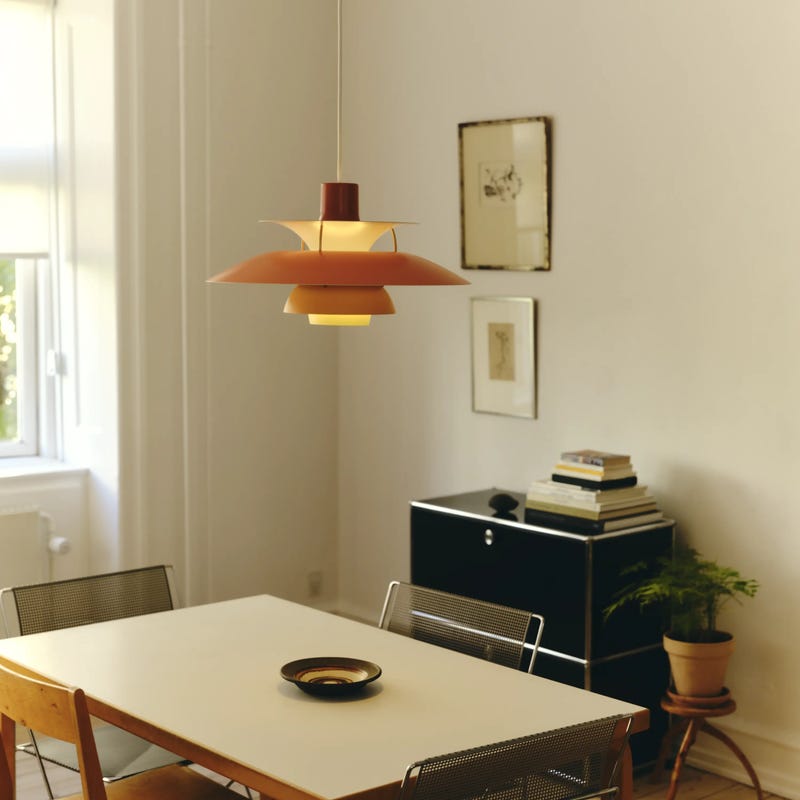
For over a dining table, PH 5 – Poul Henningsen’s 1958 pendant for Louis Poulsen – is worth considering. It was designed specifically to produce light with almost no glare. Henningsen spent years calculating the geometry: a series of shades that redirect and diffuse light downward and outward, so you never see the source directly. Above a dining table, it changes the quality of the conversation. The room feels held rather than exposed.
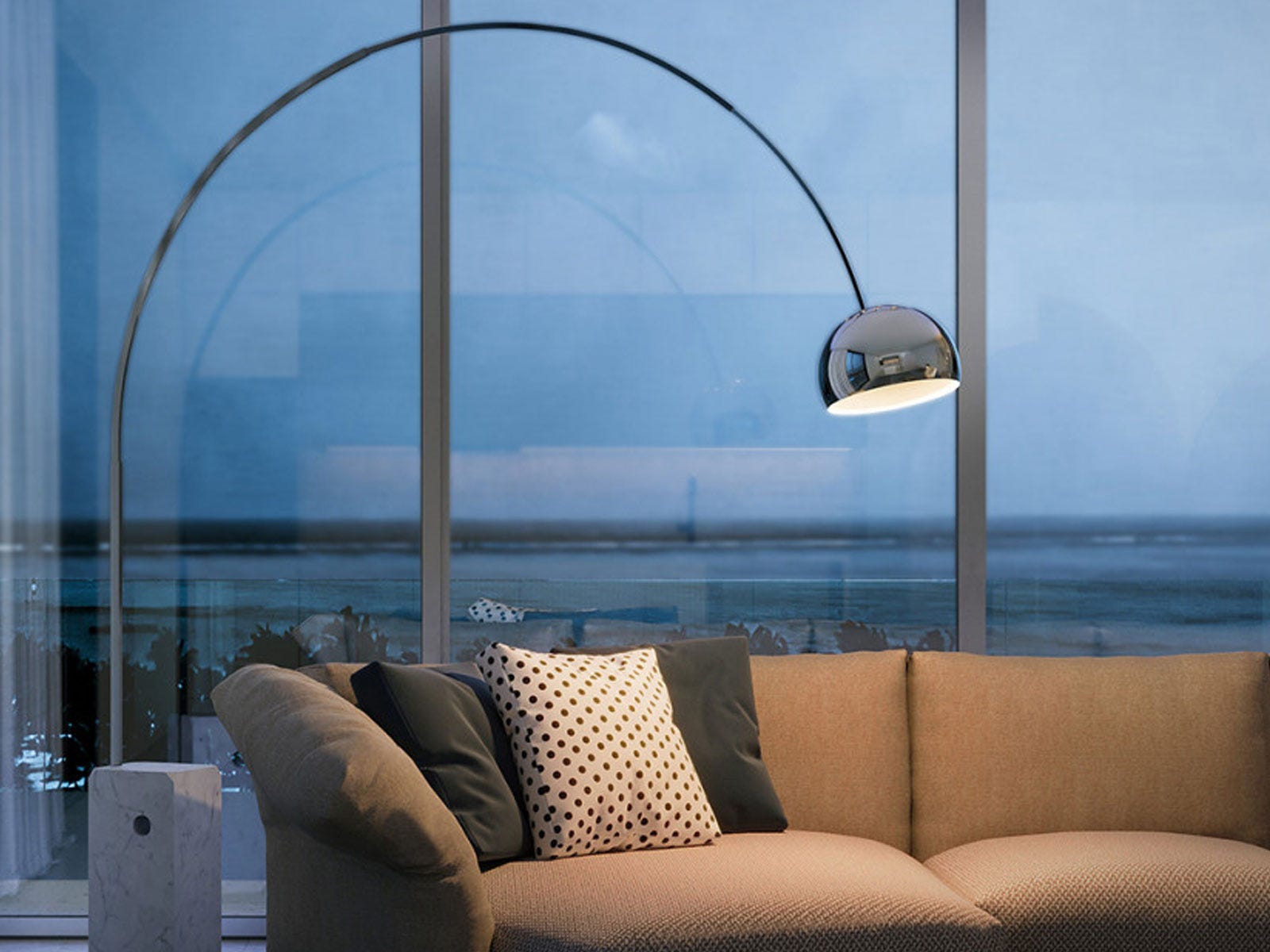
Task Lighting: The Floor Lamp
Task lighting is functional, which is why it gets overlooked in rooms that are primarily about how they look rather than how they’re used. But a reading chair with no reading light is a prop. A desk with only overhead illumination is uncomfortable to work at for any length of time.
Good task lighting is positioned close to where it’s needed and adjustable, in terms of direction and ideally brightness. It doesn’t need to be subtle. The Arco floor lamp by Flos solves the task problem architecturally: a marble base, a nine-foot arc of stainless steel, and a head that positions light directly above a seating area without requiring a ceiling fitting. It’s a floor lamp that behaves like a pendant. The marble counterweight isn’t decorative excess; it’s what makes the physics work.
The Arco is a statement piece, but the principle applies at any scale. An adjustable wall light beside a bed. A clip lamp on a shelf above a desk. The point is that the light follows the activity rather than asking the activity to move towards the light.
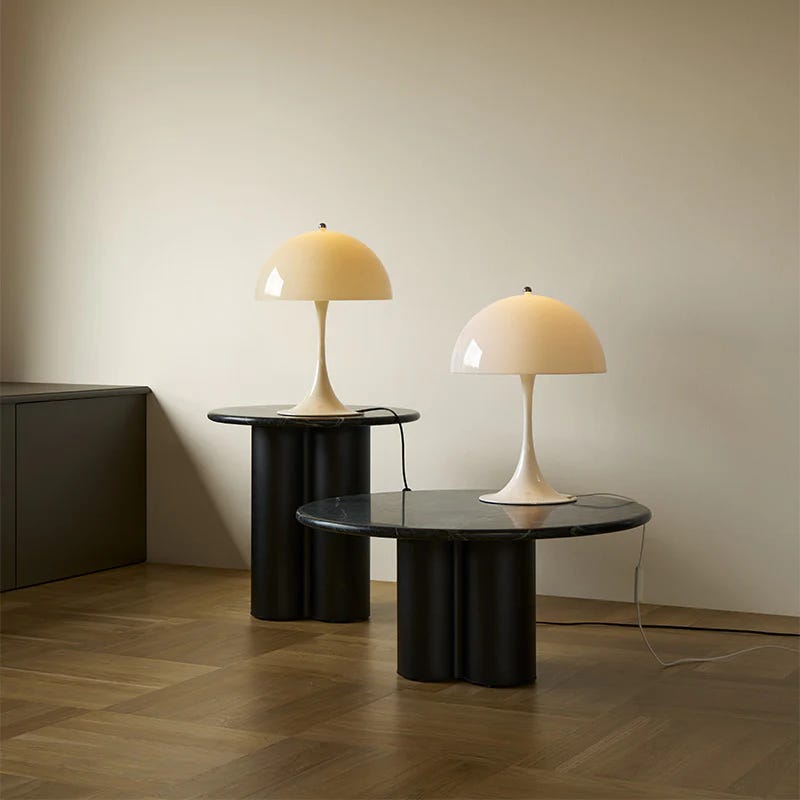
Decorative Lighting: The Table Lamp
Decorative light is the hardest to explain to someone who hasn’t lived with it. It doesn’t illuminate the room in any useful sense. It doesn’t help you read or find your keys. What it does is create the visual rest points that give a space depth after dark.
A lit candle on a shelf. A table lamp in a corner. A wall light that throws a pool of warm light upward. These are the sources that make a room feel inhabited rather than staged.
The Panthella, designed by Verner Panton for Louis Poulsen in 1971, is as close to a canonical decorative lamp as exists. The acrylic shade diffuses the light so completely that the whole form seems to glow rather than emit. It comes with a dimmer as standard, which matters. At low levels it functions almost as a nightlight, a warm point of focus in an otherwise dark room. At higher levels it does enough work to serve as ambient light in a smaller space. The Panthella Mini does this in a table lamp scale that fits almost anywhere.
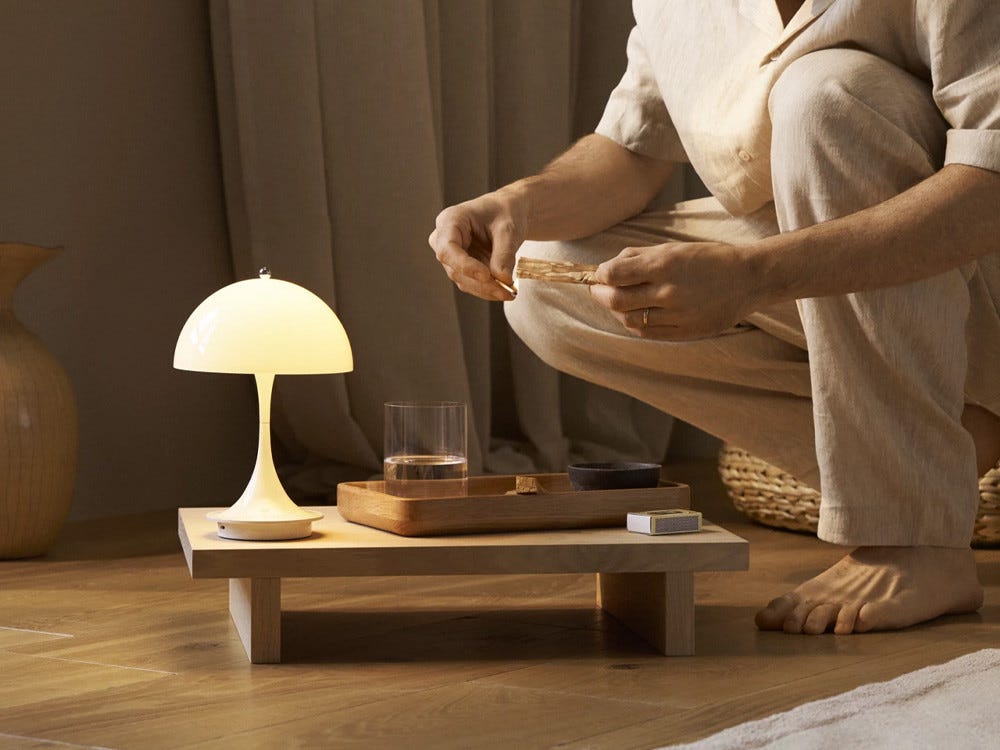
The rule with decorative light is placement more than fixture. Lower is almost always better. A lamp at eye level when seated pulls the room’s centre of gravity down and makes the ceiling recede. That’s what makes a room feel intimate rather than institutional.
Lighting Tip: The simplest rule is still the best one: for every overhead source, plan at least two additional sources at lower levels. A floor lamp and a table lamp. A wall light and a reading light. The exact combination matters less than the layering itself.