
Italy's other iconic Spider
You know the Ferrari Spider. You should know this Joe Colombo design too.

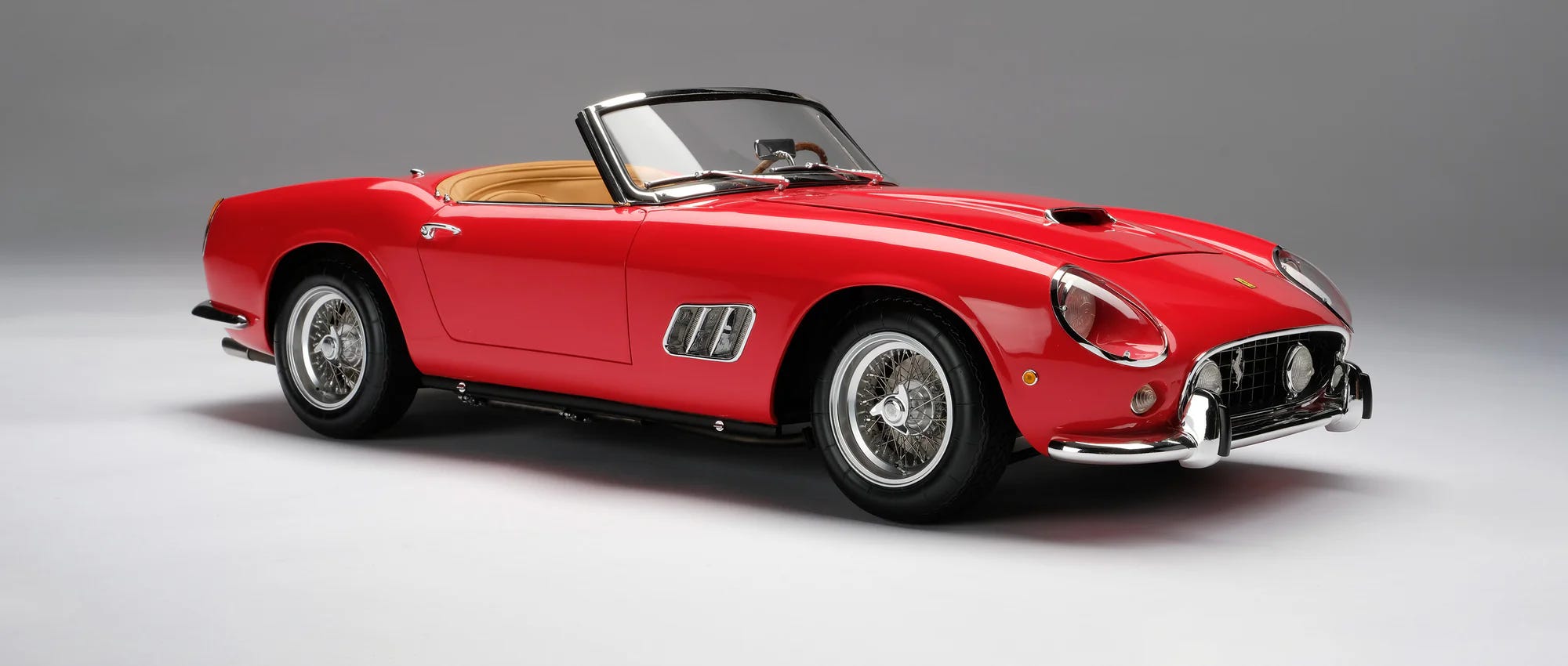
In 1947, Enzo Ferrari built his first car in Maranello. He called the open-top version a Spider — a name borrowed from the lightweight horse-drawn carriages of the 19th century, all exposed frame and no roof, built for speed rather than shelter. By the 1960s, a Ferrari Spider had become one of the most recognisable objects in the world: Italian, red, and shaped by a very specific idea of what freedom looked like.
In 1965, in Milan, a designer named Joe Colombo built a lamp. He called it the Spider too.
You probably haven’t heard of it…
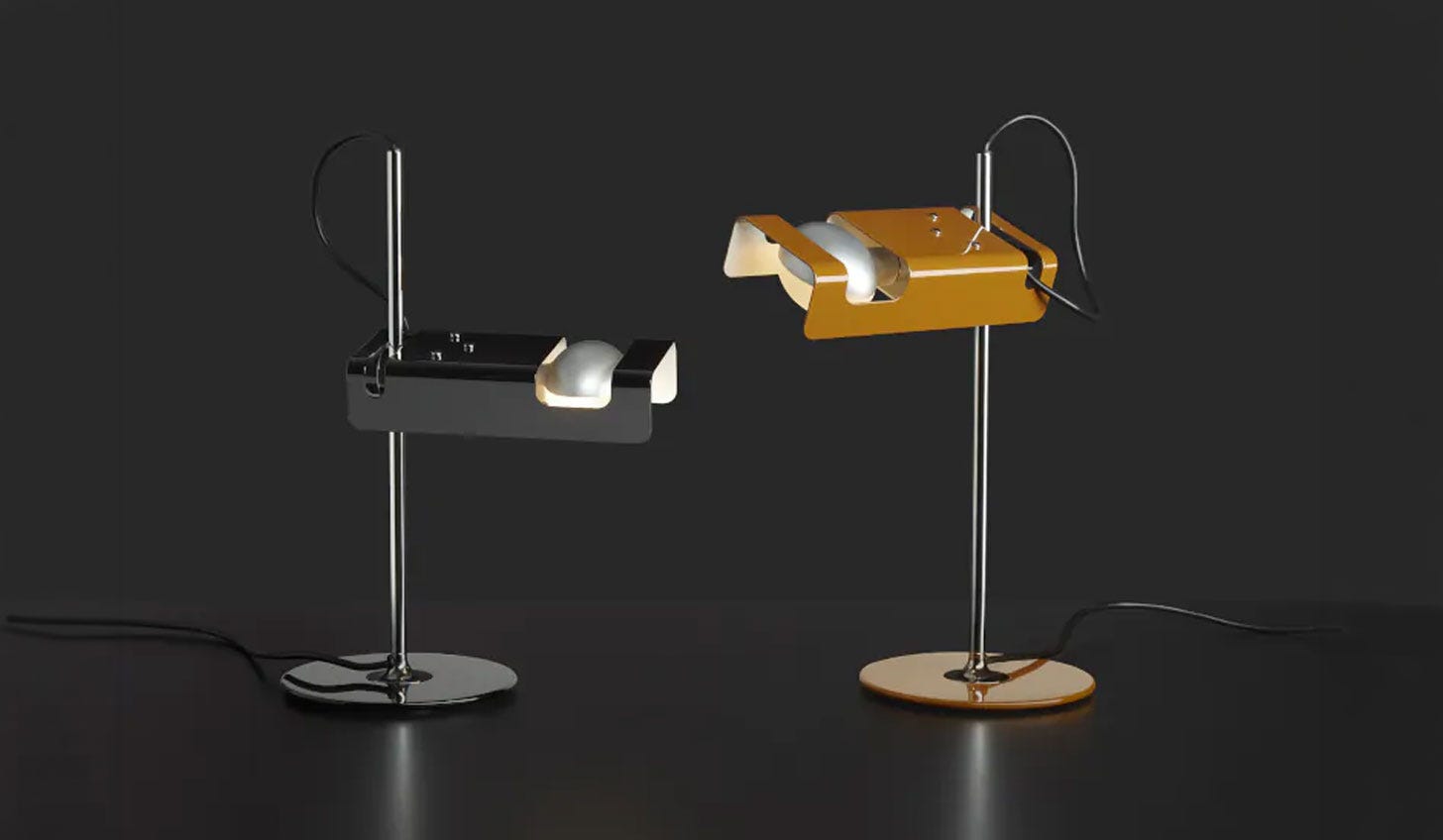
Colombo was 35 when he designed the Spider for Oluce. He had spent his twenties painting as part of the Movimento Nucleare, a Milan-based group of artists responding to the anxiety of the nuclear age with organic, fractured forms. He came to design late, switching to architecture at the Politecnico di Milano in his mid-twenties, and didn’t open his own studio until 1962. He had, in other words, about a decade.
He used it well. By the time he designed the Spider he had already begun dismantling what he called the bourgeois interior — the idea that a home was a fixed arrangement of fixed objects in fixed positions. Colombo was interested in what happened if you removed the fixedness. What if a chair didn’t have to be a chair? What if a lamp didn’t have to know where it lived?
The Spider was the answer to that second question.
The design is deceptively simple: a horizontal spotlight bulb, a sheet metal reflector built around it, and a melamine joint connecting the reflector to its support. The rotating joint means the Spider can be a table lamp, a floor lamp, a wall light or a ceiling fixture — the same object, the same mechanism, configured differently depending on where you need it. Colombo called it a “family of lamps.” What he meant was: one design solution that dissolves the distinction between lamp types entirely.
In 1965, this was not an obvious idea. The lamp market was organised around categories — you bought a table lamp for a table, a floor lamp for a floor. The categories existed because manufacturers found them useful, not because they served any functional logic. If the job of a lamp is to direct light where you need it, why should its form be determined by the surface it rests on?
The Spider won the Compasso d’Oro in 1967 — Italy’s highest design award. It is now in the permanent collections of the Philadelphia Museum of Art, the Kunstmuseum Düsseldorf, and the Neue Sammlung in Munich. Colombo was 37.
He kept going. The Coupé came in 1967 — a variation on the Spider’s base and stem, with a dome-shaped head on that same three-axis joint, now in MoMA New York. In 1970 he designed the first consumer product to use a halogen bulb. He was building furniture that contained entire rooms. He was designing environments, not objects.
On 30 July 1971, Joe Colombo died of heart failure. It was his 41st birthday.
His career as a designer had lasted nine years.

The Spider is still made by Oluce today, in Milan, essentially unchanged. A Mini Spider reissue is also available in red…Not Ferrari red, exactly. But close enough to make you think about it.
What Colombo understood, and what the Spider still demonstrates, is that the best design questions are the ones that make the category look arbitrary. Why does a lamp have to know where it lives? It doesn’t. It never did. Someone just hadn’t asked the question clearly enough before 1965.
That’s the Spider. Italy’s other one.
The Oluce Spider is available now at Utility Design, in table and floor configurations. We also stock the Coupé, the Atollo and selected pieces from across the Oluce collection — the oldest Italian lighting company still in operation, founded in Milan in 1945.